Your Competitors Are Ranking for Buyers You Haven’t Reached Yet. Do You Know Where the Opportunity Gap Is?
Have you ever searched for your own product category and found three competitors before you found yourself? That single search says more about your growth ceiling than any dashboard in your marketing stack.
Somewhere in that result page sits a buyer who already has a budget, a timeline, and a need you can solve. They are not missing from your funnel because your offer is weak.
They are missing because a competitor’s content answered a question yours never asked. Search demand is not a mystery. It is visible, measurable, and already being captured by someone in your category. The only question is whether that someone is you.
Your Competitors Have Already Done the Market Research For You
Every competitor ranking on page one for a term you have not targeted has effectively validated that demand for you. A study found that 94% of keywords showing a Google AI Overview had at least one citation overlapping the top 20 organic results, meaning organic visibility and AI citation share now move together rather than as separate battles.
That overlap matters because it means one gap analysis now closes two problems at once: the traditional ranking gap and the newer AI visibility gap.
Start by identifying your true SEO rivals rather than assuming they match your business competitors. Your true SEO rivals are whoever ranks in the top five for your core keywords, regardless of industry or business model, and you should identify them through SERP research rather than assumption.
A market intelligence firm and a niche consulting blog may never compete for the same client, yet they compete fiercely for the same search result.
Finding the Keyword Gaps That Matter
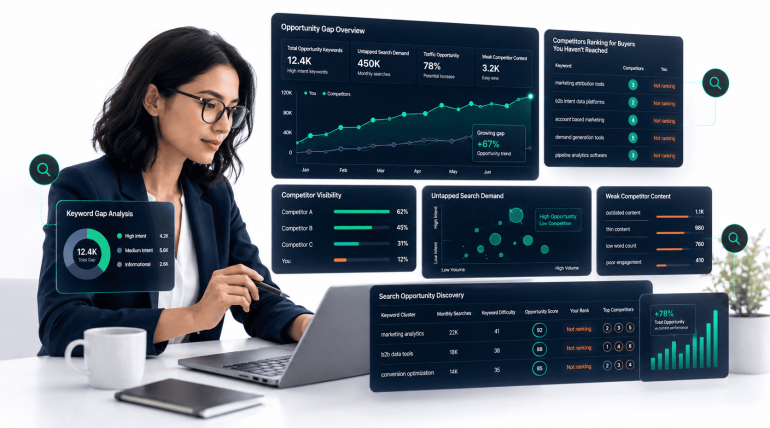
Once you have three to five real rivals mapped, a structured keyword gap report becomes your roadmap. Keyword gap analysis compares your site’s keyword rankings against competitors to identify queries where they rank in the top ten and you do not, and the resulting list represents missed organic traffic opportunities.
A competitor ranking for thousands of keywords you do not target is not a coincidence. It is a content roadmap. Sort each finding into missing, weak, or shared, so your team knows where to build and where to strengthen.
Do not stop at single keywords. Look at weak competitor content, pages that rank but answer the query poorly, and the questions your audience asks that nobody in your category has addressed properly. Question-based queries tied to buyer intent are often worth more than high-volume informational terms that attract visitors who never convert.
This is where UAE and MENA businesses hold a structural advantage most have not claimed. Brands that invest in bilingual English and Arabic SEO effectively double their indexable footprint, capturing market segments that English-only competitors completely miss.
Companies implementing proper bilingual optimization typically see 37% more conversions than those focusing on a single language. If your competitors are only publishing in English, the Arabic-language version of your buyer’s question may be sitting completely uncontested.
SERP Weaknesses and Emerging Category Demand
A ranking page is not automatically a strong page. Study who wrote it, whether it contains original data, and how it structures its answer for readers and for AI systems scanning for a citable source. Where a top-ten result is thin, outdated, or generic, you have found a weakness worth exploiting.
Emerging topics deserve the same scrutiny. If a competitor published a wave of articles on a topic and is now ranking for it, that signals the topic is gaining traction, and you can still enter the conversation early.
Category-level demand, the broader theme rather than any single keyword, tells you where a market is heading before volume data catches up.
Prioritize by Business Relevance, Not Volume
This is where most gap analyses fail. A 20,000-search keyword dominated by five authority sites you cannot outrank this year is a worse investment than a 500-search keyword that sits one blog post away from your highest-value service page.
A high-volume keyword gap with no commercial relevance is not a priority. Always filter gap opportunities through commercial intent before search volume. The strongest scoring frameworks weight each gap by search volume, keyword difficulty, business relevance, meaning how closely ranking for the keyword connects to a revenue outcome, production effort, and time-to-rank potential.
For UAE and GCC businesses, prioritization must account for realities generic frameworks miss. Attribution gaps created by WhatsApp-driven conversations, offline closes on high-ticket B2B deals, and bilingual search behavior all distort what a keyword tool reports as valuable.
A gap that looks modest in raw volume can be your highest-converting page this year, once you account for how your buyers actually search and switch languages mid-session.
The Opportunity Gap Is a Market Intelligence Problem
Treat search demand data as a market intelligence input, not a marketing metric sitting off to the side. Every gap on that report is a documented signal of what a buyer in your category wants right now. Evidence before opinion means building your content calendar from what the SERP proves people search for, not from what your team assumes they want to read.
Ready to Find Your Opportunity Gap?
KEPLA’s Market Intelligence and Go-to-Market Strategy services turn competitor keyword data into a prioritized content and growth roadmap built for how UAE and MENA buyers actually search. If you are ready to see exactly where your opportunity gap sits, reach out to KEPLA to start the analysis.