If Buyers Get Their Answers Without Clicking Your Website, What Should Your SEO Strategy Optimize For?
Have you searched for something on Google this week and left without clicking a single link? If you have, you are not the exception. You are the majority. 68 percent of Google searches now end without a click to any website, up from just over 60 percent two years ago.
When an AI Overview appears, that number climbs past 80 percent. For founders and marketing leaders across the UAE and wider MENA region, this is not a distant trend. It is the discovery environment your buyers already live in. Your pages can rank. Your keywords can be technically flawless.
None of that matters if the answer your buyer needed was already delivered on the results page, by a system that never sent them to you.
The Discovery Environment Has Already Changed
The shift is measured behavior, not a forecast. SparkToro’s analysis of Similarweb clickstream data found that zero-click searches in the United States rose from roughly 60 percent in 2024 to 68 percent in early 2026, the steepest two-year increase the firm has recorded. Out of every 1,000 Google searches, only about 276 now send a visitor to the open web. The rest resolve on the results page itself, through AI Overviews or instant answers.
This is not only a Google phenomenon. Similarweb‘s 2026 GenAI Landscape research notes a typical ChatGPT prompt runs around 60 words, compared with roughly three words for a Google search.
Buyers researching a market entry or vendor comparison no longer type fragments into a search box. They ask full questions to an assistant, and the assistant answers on their behalf, sometimes without surfacing a website at all.
Search Intent Still Comes First, But the Destination Has Multiplied
Search intent has not stopped mattering. It has multiplied across surfaces. A buyer researching “market entry strategy UAE” may see a traditional organic result, an AI Overview, a Perplexity summary, or a ChatGPT answer, depending on where they searched. Each system interprets intent differently, but all reward the same discipline: content that answers a specific question rather than one that talks broadly around a topic.
For SMBs and marketing teams building an SEO strategy in 2026, intent mapping can no longer stop at a keyword list. It has to account for the sub-questions a buyer is likely to ask, and whether your content answers each one directly enough to be lifted into a synthesized response.
Topical Authority and Entity Relevance Replace Keyword Density
AI systems do not evaluate a single page in isolation. They evaluate whether a brand, as an entity, has demonstrated consistent authority across a topic. GEO researchers describe this as entity clarity, the degree to which AI systems can confidently associate your brand with a specific domain of expertise.
This is where topical authority compounds. A single well-optimized article rarely earns durable citation. A body of consistently updated, evidence-backed content across a defined topic, such as market intelligence or go-to-market strategy, builds the authority AI systems return to repeatedly.
Internal linking between related articles, rather than isolated one-off posts, has become a measurable citation factor, not a cosmetic one.
Answer-Friendly Content Built on Original Evidence
Structure now carries as much weight as substance. GEO research from Similarweb found content strengthened with original statistics and sourced quotations achieved 30 to 40 percent higher visibility in AI-generated responses than unmodified content, while keyword stuffing performed below baseline.
Front-loading the direct answer, rather than burying it beneath a long preamble, makes it easier for AI systems to extract and cite accurately.
This rewards the discipline KEPLA applies to every piece of analysis: evidence before opinion. Original data and clearly attributed findings are increasingly the raw material AI systems select when deciding which source deserves to shape an answer.
Structured Information and Expert Perspectives
Machine-readable structure, including clear headings, schema markup, and question-and-answer formatting, helps both crawlers and AI retrieval systems parse a page accurately. But structure alone is not enough.
GEO analytics firm Erlin found 68 percent of AI citations come from third-party sources rather than a brand’s own website, and competitor displacement causes roughly 80 percent of lost citations.
Earned mentions on trusted platforms and expert commentary now carry more citation weight than owned content alone.
Brand Mentions and AI Citation Potential: The New Scoreboard
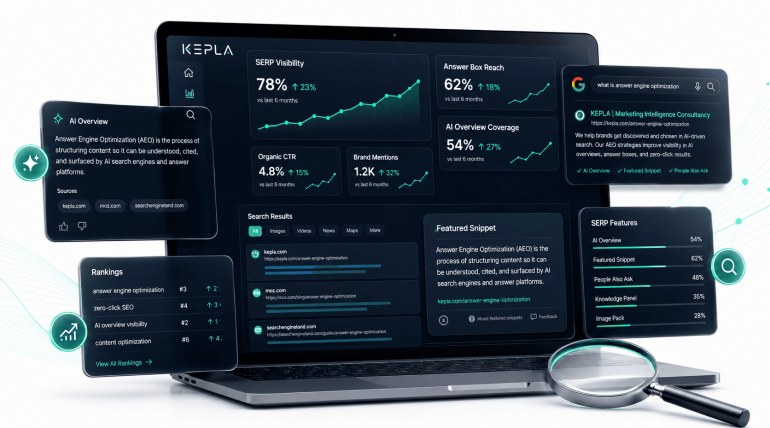
The metrics that mattered five years ago are no longer sufficient alone. Rankings and click-through rate still matter, but they describe a shrinking share of the discovery journey. Brands cited inside AI Overviews see gains in adjacent organic click-through rate, and visitors who arrive via AI-powered search convert at markedly higher rates than standard organic traffic, because they arrive already informed.
Measuring success in 2026 means tracking brand mentions, citation frequency, and share of voice across AI answer engines alongside traditional search visibility.
What This Means for UAE and MENA Businesses
The MENA discovery journey adds a layer most global SEO commentary overlooks. A significant share of buyer conversations here move to WhatsApp before a decision is made, and offline follow-through remains common across B2B and premium consumer categories.
If your measurement stops at website clicks, you are already missing where zero-click search hands off to a direct, private conversation that never appears in your analytics. Building visibility across AI answer engines, search, and the offline and messaging channels where GCC buyers actually convert is what separates brands that are seen from brands merely indexed.
Where This Leaves Your Strategy
The businesses gaining ground in 2026 are not chasing every AI search headline. They are building the fundamentals that have always defined durable visibility: original evidence, structured expertise, and consistent topical authority, extended to an environment where the destination has multiplied.
At KEPLA, this is the standard we apply to every piece of market intelligence we produce, business before marketing, evidence before opinion, so the answer reaching your buyers is grounded in something real.
If your SEO strategy still measures success by rankings and clicks alone, it is time to ask a harder question: what is your content actually optimizing for now?
Ready to build an SEO strategy that holds up in an AI-first search environment? Talk to KEPLA about a market intelligence audit that maps your brand’s real visibility across Google, AI Overviews, and answer engines.